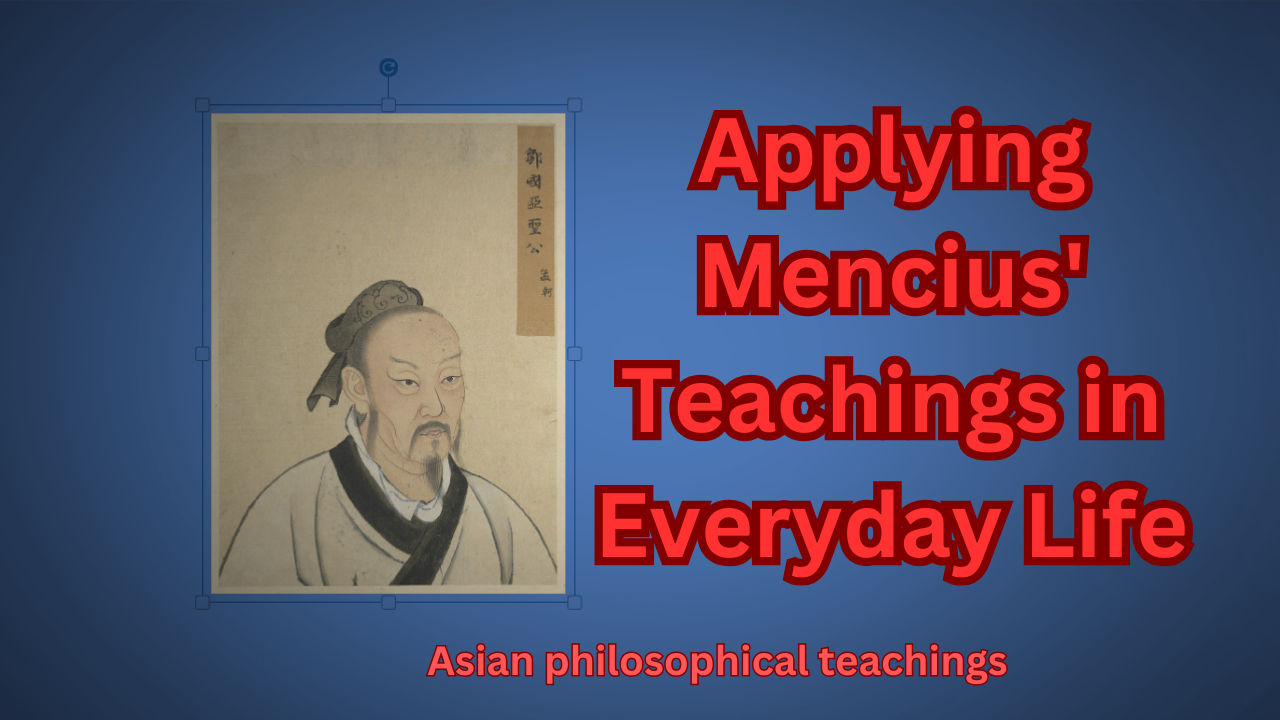
How we can apply Chinese Philosophers Mencius teachings in personal life

Hello and welcome to this video. In this video, we explore the teachings of the ancient Chinese philosopher, Mencius. It’s commonly believed that Mencius lived during the emergence of city states. Most of his teachings focused on enhancing state-related affairs, but in this video, we explore how we can apply his teachings in our personal lives.

So the question is: who is Mencius? Even before choosing this topic, I did not know him. Mencius is considered to be the second saga of Confucianism. He lived in 289 BC. He lived during the Chinese Warring States period approximately 2,300 years ago. He expanded and finalized Confucius’ teachings.

According to Mencius, every human is born with a righteous or upright nature. Later in life, they may lose their way. Their circumstances or environment shaped them, and they lost the right path. According to him, with proper nourishment and care, everything grows, and without the proper nourishment and care, everything degenerates or decays.

Now we discuss four innate virtues in humans. Often referred to as the four beginnings or the four seeds of goodness, I have mentioned them and provided a brief explanation to help us apply them to our personal lives.

  1. Sense of Compassion (仁, Ren): On a personal level, we need to practice empathy in our interactions with others. Always consider their feelings and strive to comprehend their perspective by putting ourselves in their shoes. Help and support them in their day-to-day tasks. Seek opportunities to assist them with their daily tasks and issues. implement a sense of compassion.
  2. Sense of Shame and Disdain (義, Yi): Understand and always act on those things that are morally right. Try to avoid acts that are morally wrong. Make choices and decisions based on a moral compass.
  3. Sense of Respect and Reverence (禮, Li): Many times we think of breaking social norms and traditions. But that is not the right virtue. Always respect social norms and traditions.
  4. Sense of Wisdom (right and wrong) (智, Zhi)**: Seek knowledge and understanding in every situation. Reflect on your experiences and learn from them. Use your life wisdom to make good decisions.

We can apply Menicus teaching by reflecting on our lives. Regularly reflect on your actions and interactions. Evaluate your actions with respect to your values. If this isn’t the case, it’s important to make changes in your life. Always maintain the belief that every individual possesses a good nature from birth. If a person exhibits negativity, it’s likely due to external circumstances. Always focus on helping and your fellow beings. Always seek balance in life.

I hope friends like this video. Mencius focuses on moral virtues. We can improve our lives by adhering to these rules.
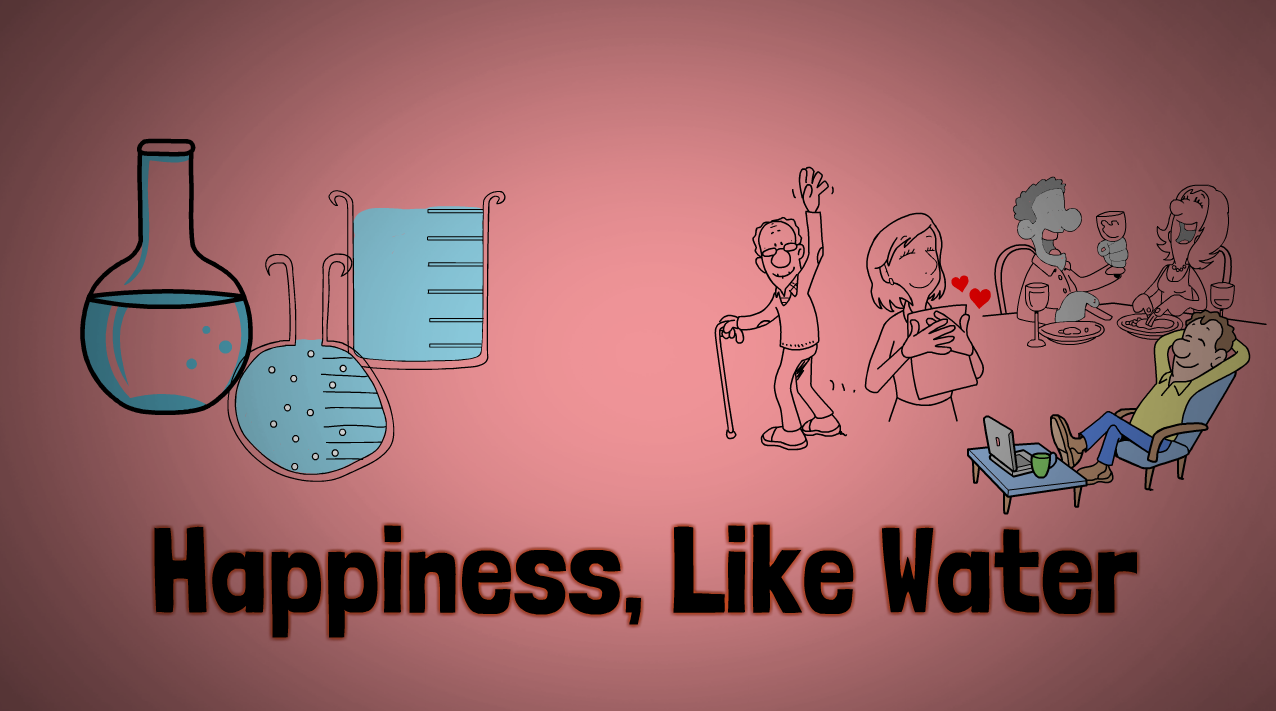

Why Happiness is Like Water

I believe that happiness is a state of mind. When we are happy, certain harmonics release in our minds, leading to a sense of pleasure. and what is meant by “happiness like water.”.

This means that water can fit into any type of pot. Then you can be content and joyful in any situation. Let’s discuss. Once, I was asking myself whether happiness comes from outside our environment, an external factor, or is born inside us. Is it within or beyond our control? Once upon a time, I believed that couples and lovebirds held the key to happiness. However, I discovered that many once-loved and ideal couples do not experience true happiness. I was thinking that achieving something makes you happy. Then I saw a lot of high achievers with successful lives who were unhappy and disappointed. I found that competition makes us happy. When we demonstrate our superiority over others, we feel joy, happiness, and pride. We feel joy and happiness, as well as pride. The other person’s defeat makes us pleased and full of joy. This can also lead to feelings of depression and anxiety. On the other hand, I realized that the person with whom I compete is happier than me because he accepted his life and found meaning in it. Similarly, people who live in large houses, own expensive clothes, and drive expensive cars are not necessarily happy. Conversely, those who are less privileged tend to be happier than their counterparts. Even I saw a homeless person with torn clothes enjoying his life. So what’s wrong with happiness? Achievers, winners, and wealthy people are also unhappy. Even those who have nothing in their lives find happiness and contentment. I began to understand that it was merely a state of consciousness. It is up to us to make life by thinking and acting. Then there is the story of Gautama Buddha: who lived a happy and peaceful life. When he saw misery, death, and old age, he tried to find solutions to world problems. But after deep meditation, he found only one solution. Detachment. Suffering comes from attachment. The way to be happy is through detachment. Make your wishes less. Accept life as it is. Think about what happened. That is for good. Buddha said “There is no path to happiness; happiness is the path. “Happiness comes when your work and words are of benefit to yourself and others.”

https://www.youtube.com/watch?v=GH7cxp8HCvM

“Thousands of candles can be lit from a single candle, and the life of the candle will not be shortened. Happiness never decreases by being shared.” Buddhist ways of achieving happiness are compassion and mindfulness. Midfulness means keeping your mind busy with things and thoughts. Focus on what’s happening in the present moment.Compassion: Keep busy and help others reduce their misery and problems. Let’s explore more about what Stoics said about happiness and how to attain it. Seneca said that “True happiness is to enjoy the present without anxious dependence upon the future.”

Epictetus said that    “Happiness and freedom begin with a clear understanding of one principle: Some things are within our control, and some things are not.” Similarly Marcus Aurelius said that “Very little is needed to make a happy life; it is all within yourself, in your way of thinking.” According to Stoic philosophy, happiness comes from only focusing on things that we can control. Let go of things that are beyond our control. Just focus on your actions, thoughts, and reactions. The second method involves dedicating yourself to a high purpose or higher virtue and maintaining a busy schedule to attain it.  The third option is to be mindful. Mindfulness means just living in the present moment. Enjoy the present moment. Stoics believe that thinking about the future and past hurts our happiness. What I now understand is that happiness originates within us. Regardless of the situation, it’s up to us to stay happy, depressed, or worried. Accept life as it is. Stay in the present moment by simply making conscious efforts to observe what’s going on and stay busy. In conclusion, happiness is like water. Just as water settles in any pot, so too does happiness. Similar to water, happiness can settle in any situation. It’s up to us how we maintain our happiness.See you in another video.

Why short term goals are more important

Goal-setting is essential in life. Those who achieve success in life often have specific goals in mind. Some have written goals; others keep them in mind. The law of attraction, or manifestation, only works when you have goals. The only difference between a wish list and goals is the deadline. Until we begin working towards achieving them, goals remain merely wishlists. 

Why is goal-setting important?

Know what you want and set future goals to be happier and more successful. Goals help us sense where we are going and focus on the objectives we want to achieve. In times of adversity, it gives us motivation and keeps us inspired. Goals are also helpful in assessing our progress. Goals help us become more accountable, and we can improve our accountability in work and professional life. Direction and Focus: We reach some places, but we do not have clear goals. But there are problems. But on the other hand, there are also problems. Sometimes we set unrealistic goals. We spent too much time just thinking and planning. When you start putting in effort and results are not coming, instead of adjusting our sail, we start to be frustrated. My personal experience has shown that our long-term goals often lead to problems. It’s very unclear what the situation will be after 10 to 15 years. The human mind can perceive a situation for a maximum of three months, which allows us to understand our current circumstances from a vantage point. Our vision cannot go beyond 3 months.

Recently, I read a few quotes that all had a similar message. Lord Chesterfield said,

“Take care of your minutes, and the hours will take care of themselves.”

Lord Chesterfield advised focusing on the tasks you need to complete at the moment to reach your goals. Leave the hours to consider how you want to plan out your life.   Then, in the near past, Ramana Maharshi, an Indian guru, had two similar quotes.

The first one is “Engage yourself in the living present. The future will take care of itself.”

“Why should you concern yourself with the future?” You don’t have a comprehensive understanding of the present. Take care of the present; the future will take care of itself. “

These three quotes mentioned only one thing: just focus on the present moment. To focus on the present moment means to concentrate on short-term goals. Why is it important to have short-term goals? The secret to success is to set short-term goals. Short-term goals are visible and easily achievable. And more importantly, you can verify what you achieve.

 In Dale Carnegie’s How to Start Living and Stop Worrying, I read a quote from Thomas Carlyle.

“Our main business is not to see what lies dimly at a distance, but to do what lies clearly ahead.” 

 Long-term goals are just vision. They hide in mist and dust. We cannot see far from now. If you still have long-term goals,. Then just write down these goals. Just set short-term goals. Align these short-term goals with your long-term objectives and concentrate on them. I hope you like this video. If you have goals, then you certainly have a happy life. Your future is bright. If you don’t have goals, drift along. Just start sitting down. Write down what you want and start from where you are. Life will not change until you do not start acting.

The most effective way to engage in a conversation

  • Practice small talk.
  • If it is face-to-face, then you must know the other person’s interests.
  • face-to-face.  Listen to another person in conversation.
  • Let them speak.
  • Listen focus.
  • Repeat and rephrase other words.
  • Encourage others to speak.
  • Take a pause, then share your point of view.
  • Listening helps us understand other people’s points of view.
  • If you disagree, then criticise his words or sentences, but never attack another person.
  • Avoid personal attacks.
  • Share your idea and its benefits.
  • Share what you think the other person points out, as well as why your idea is better than his or hers.
  • Give other person to save pace.
  • Conclude on common points and agreement.
  • If another person’s point of view is right, accept him.
  • The other person should sense that you are listening to him.
  • If there is a formal meeting, let them win.
  • Try to win only when it is necessary and something you want to achieve.