Many times in life, we don’t have mentors, or there’s no one around to guide or teach us. This could be due to various reasons—like your personal reputation, your company’s image, or just a sense of privacy.
As we reach a certain stage in life, we often find it difficult to discuss our problems openly. While others might offer advice, their perspective is based on their own experiences and circumstances—which may or may not apply to us.
So what’s the strategy in such a situation? We must learn to become our own mentor or guiding light.
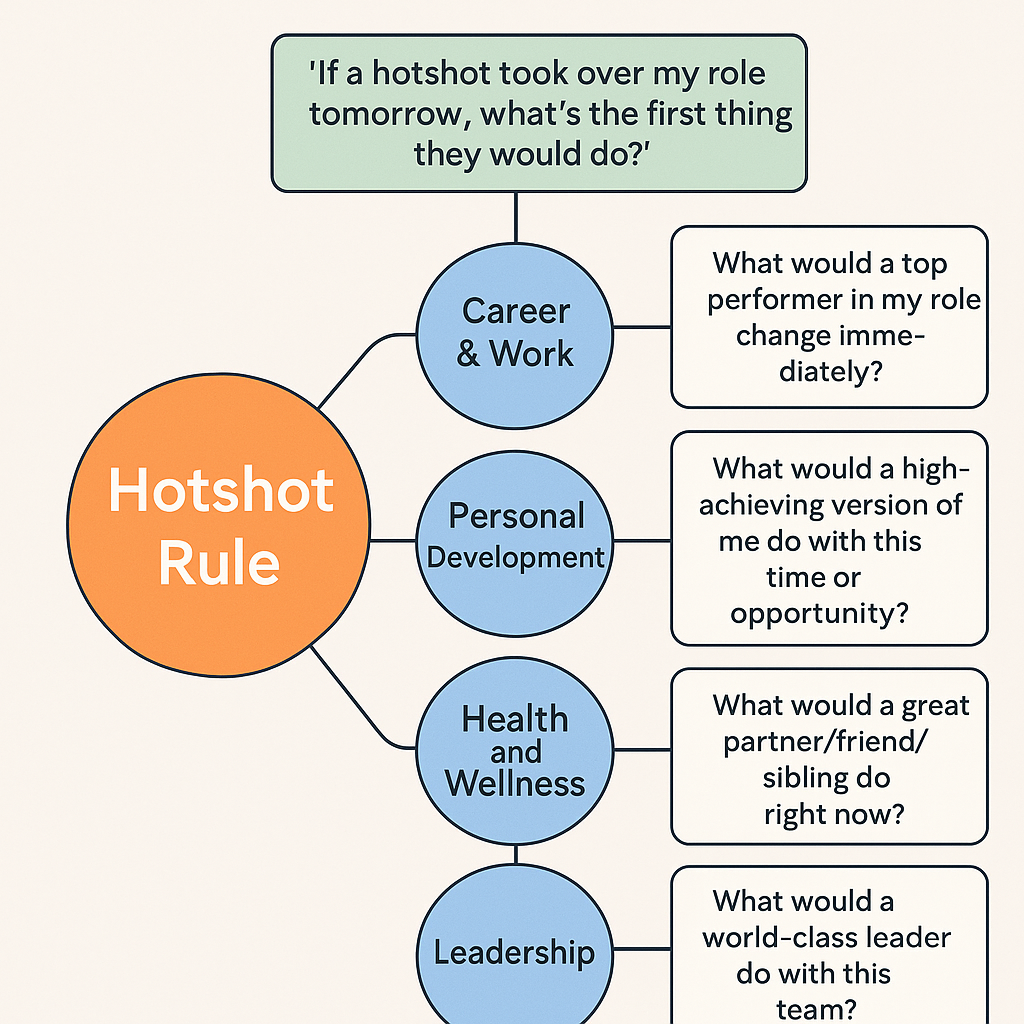
Recently, I came across a TED Talk by a CEO named Kat Cole. She shared a powerful method that helped her think differently and move forward in her professional journey. The tool she mentioned is called the “Hotshot Rule.” It became a game-changer for her career—and it can be applied by anyone: a developer, a CEO, a teacher, a father, or a mother.
The idea is simple: Ask yourself—if someone smarter than you were to replace you tomorrow, what’s the first thing they would do? Then—go and do that thing immediately.
When we take on a new role, we often see things with fresh eyes and act decisively. But over time—3 years, 3 months, 4 weeks later—we may lose that clarity. This method helps us regain that fresh perspective.
Also, remember: there’s always someone smarter than you. But instead of waiting for them to replace you—why not replace your old self with a better version of you?
This approach allows us to see through someone else’s eyes—to understand the situation clearly and take meaningful action. And action creates impact.
So how can we apply this in our lives?
First, take full responsibility for all areas of your life.
Then, choose one area—whether personal or professional.
Think of the smartest person you admire as your mentor.
Review that area through their mindset.
Then, take the necessary actions—decisively and without delay.
I was reading a quote recently that made me reflect deeply on my life. It said, “The quality of our life depends on the quality of questions we ask ourselves.” This quote is often attributed to Tony Robbins, and its meaning is both simple and powerful: when we start seeking answers, we invite change into our lives—and when we ask the right questions, that change becomes meaningful and transformative.
Think about it—whenever you face a negative situation, the way you respond begins with the kind of question you ask yourself. If your first thought is, “Why does this always happen to me?”, you’re asking a reactive question that may lead to some answers, but not the kind that move you forward. These types of questions are common and natural, but they rarely lead to growth. On the other hand, empowering questions can shift your mindset and open doors. You might instead ask: What can I learn from this situation? How can I respond differently next time to get a better result? What small change can I make so this doesn’t happen again?
One of the most profound questions I’ve come across comes from Meditations by Marcus Aurelius. He writes, “Ask yourself at every moment, ‘Is this necessary?’” It’s a simple practice of mindfulness that invites clarity and intention into your actions.
That led me to wonder—what if we asked better questions in every area of life? What if we were intentional not just during tough times, but in our approach to health, learning, relationships, careers, and finances?
The first step is always to assess your current situation. Without a clear understanding of where you are, it’s hard to move in the right direction. For example, in your financial life, you might start by asking: What are my current savings? What debts do I have? What are my spending habits each month? If you can’t answer these clearly, spend at least one month tracking your money. Clarity comes through awareness.
Once you have a clear picture, begin asking deeper, quality questions that can lead to change. Questions like: What are my biggest unnecessary expenses? What percentage of my income am I saving? Am I consistently spending more than I earn? What emotional triggers lead me to spend? And perhaps most importantly—are my financial habits aligned with the life I truly want?
This principle applies across all areas. But it all begins with this: the quality of your thoughts. When your thoughts are mindful, intentional, and rooted in the present, you elevate the quality of your entire life.
So take a pause. Look at your life. And start asking better questions.
While reading about self-love, an old memory resurfaced. Someone once tried to remind me of my “Aukaat”—a word that signifies one’s status or worth in life. He told me I did not deserve the best, while he did. “Toh apni Aukaat bhool gaya hai?” he said.
Sometimes, I revisit those words. Why should I not deserve better while others can?
At times, I wonder if “Aukaat” simply means one’s reality, one’s limit. As Chattan Bhagat once pointed out, there is no equivalent word for “Aukaat” in some other languages.
When people remind you of your Aukaat, they are not offering wisdom—they are trying to suppress you, to keep you beneath them. “Teri itni hi Aukaat hai, jo hamara muqabla kar raha hai?” they say, as if worth is something dictated by others.
But with time, I realized a deeper truth: people control others by controlling their thoughts—by suppressing their beliefs about what is possible.
That day, I made a decision. You defined my Aukaat for me once, but one day, I would define it for myself.
And today, when I look at my achievements and compare them to their lives, I see the truth—they were wrong. They were liars. I have accomplished much.
So, remember: when someone tries to tell you your Aukaat, they are not revealing your limits. They are exposing their own. How to change your Aukaat is to take responsibility of your life. Goals and effort to change effort. it take time.
I have been listening to a lot of content on deep thoughts. Do thoughts lead to action? “Karam” means action.
Now, I am realizing that thoughts have a significant impact on us.
Many times, when I travel long distances, past thoughts resurface in my mind. When I repeatedly think about them and try to justify myself, I notice a pattern—these thoughts often lead me to feel depressed. I question why certain things happened to me, and this realization was my first eye-opener.
It feels true that everything starts with a simple thought, and suppressing our thoughts can lead us to suppress others as well.
While staying with a relative, I remember being criticized. At first, I thought it was meant to help me improve, but later, I realized it was an attempt to suppress me. Sometimes, I feel that people appreciate those who follow their wishes, stay within their expectations, and remain beneath them.
So, I have learned to observe my thoughts. The past is over, and I cannot change it. However, I can choose to stop dwelling on it. The future is yet to come, so I focus on the present moment.
I recently came across this quote, and it caught my attention:
“An expert is a person who has made all the mistakes that can be made in a very narrow field.” — Niels Bohr.
This quote is fascinating because it highlights how someone becomes an expert. Expertise isn’t achieved overnight—it comes through trial and error. A person starts working toward a goal, makes mistakes, learns from them, and gradually improves.
What’s even more interesting is that if a person doesn’t learn from their mistakes, they remain at the same level. Facing failure is tough, especially when you find yourself making the same mistakes repeatedly. But those who embrace their mistakes, analyze them, and adapt are the ones who grow.
This quote resonates deeply with my own life experiences. It reminds me that expertise is built on persistence and resilience.
So, when someone asks, “How do I become an expert in any field?” The answer is simple: Have the will to start, make mistakes, correct them, learn from them, and repeat the process.
Meet Alex. He’s ambitious, works hard, but feels stuck. He sees others succeeding and wonders Why not me?
But here’s the truth… everyone struggles with self-doubt. Even the most successful people felt lost at some point.
Lesson 1: No one has all the answers. Just start!
Alex, hard work isn’t enough, Sarah says. Opportunities don’t just happen—you have to create them.
Alex realizes that waiting for luck is useless. He has to take action.
Lesson 2: Stop waiting. Take action.
He panics I have never done this before! But instead of saying no, he remembers… Say yes. Figure it out later.
Draw Alex researching, learning, struggling, then presenting a successful project.
Lesson 3: Growth comes from discomfort.
He starts building his personal brand—writing articles, making connections, and sharing his work.
Lesson 4: You are your own brand. Invest in it.
He understands that talent isn’t everything. Relationships matter.
Lesson 5: Success isn’t just skill—it’s how you treat people.
For weeks, he feels like a failure. But then he realizes… failure is just feedback.
Lesson 6: The most successful people are the ones who never quit.
He starts questioning What am I really working for?
Lesson 7: Set boundaries. Your life matters too.
He realizes the truth… mindset is everything.
Final Key Takeaways: Stop overthinking. Just start. Build your own opportunities. Treat people well. Never stop learning. Take risks, embrace failure, and keep moving.
Call to Action: If this story inspired you, like, subscribe, and share** this video. Your journey starts NOW!
I was wondering if it is true that the most successful person in any field is the most talented one. Later, I realized that this is not the case. Most people who are successful in a specific field or career are not necessarily the most talented. Talent matters, but work ethic, effort, and dedication matter even more.
I was reading Angela Duckworth’s book Grit: The Power of Passion and Perseverance. In it, she mentioned that talent multiplied by effort equals skill, and skill multiplied by effort equals achievement.
All successful people have achieved great things in life. A less talented person who puts in effort can become successful, while a talented person who does not put in effort may not achieve the same level of success. Talent is important, but effort has a greater impact.
Hey everyone, welcome back to our channel! Today, we’re diving into a transformative topic: how to navigate life as a sensitive person by applying the wisdom of The Four Agreements by Don Miguel Ruiz. If you’ve ever felt overwhelmed by your emotions or the opinions of others, stick around. This video might just change your perspective!
Understanding Beliefs
As children, we absorb beliefs based on our experiences, the challenges we face, and how we interpret situations. These beliefs shape our view of the world and ourselves. But here’s the catch: many of these beliefs are based on agreements we make with ourselves—rules about what we should or shouldn’t do.
As we grow, we often judge others through the lens of these agreements, reinforcing our own beliefs about what’s right or wrong. This can lead to a rigid belief system that’s hard to break. And remember, if hell is a state of mind, we can find ourselves living in it when we endlessly punish ourselves for past actions.
The Impact of Negative Agreements
We face daily challenges, and if our internal agreements are negative, they can drain our energy and well-being. But here’s the good news: we can build new agreements that empower us and lead to personal growth. Let’s explore the Four Agreements that can help us transform our lives.
Agreement 1 – Be Impeccable With Your Word
The first agreement is to be impeccable with your word. Our words hold incredible power—not just over others, but over ourselves. The Latin root of “impeccable” means “not sinful,” so let’s strive to use our words positively.
Many of us engage in negative self-talk, which stops us from taking action. Instead, replace those thoughts with uplifting affirmations. Remember, our words can either build someone up or tear them down. Choose to spread positivity and let your words shine!
Agreement 2 – Don’t Take Anything Personally
The second agreement is don’t take anything personally. It’s easy to let others’ words affect our mood. When we feel criticized, we often react defensively, creating conflict.
But here’s a crucial insight: what others say is a reflection of their reality, not ours. By not taking things personally—whether praise or criticism—we free ourselves from unnecessary emotional turmoil. Your self-worth should come from within, not from external validation.
Agreement 3 – Don’t Make Assumptions
The third agreement is don’t make assumptions. Assumptions can lead us to misunderstand situations and people. Instead of jumping to conclusions, ask questions to gain clarity.
This practice not only prevents unnecessary conflict but also helps you understand your true desires. Remember, communication is key to breaking down barriers!
Agreement 4 – Always Do Your Best
Finally, the fourth agreement is always do your best. This doesn’t mean striving for perfection; it’s about putting in your best effort in each moment. When we detach from the outcome and focus on the process, we alleviate pressure and allow ourselves to grow.
Life is about progress, not perfection. Embrace where you are now, and do what you can with what you have.
Implementing the Agreements
To implement these agreements and break free from old beliefs, start with awareness. Recognize your self-limiting beliefs and the fear that holds you back.
Transformation requires a willingness to change and the courage to face discomfort. Intent is essential—approach this journey with pure, unconditional love for yourself.
By applying these Four Agreements, you can reshape your reality, especially as a sensitive person navigating a complex world. Remember, change takes time and practice, so be patient with yourself.
If you found this video helpful, please like, share, and subscribe for more content on personal growth. Let’s create a community of support and empowerment!
Thanks for watching, and until next time, take care of yourselves and each other!
While driving to the office on a long bike ride, my mind continuously wandered to the past. I kept thinking, What happened to me? Why did that happen to me? By the time I reached the office, my mood had turned sour.
During the ride back home, while driving my bike, my mind shifted to the future. As a result, I felt stressed.
When I sat in silence, I began reflecting on what had happened to me. Why was I so sad? Why was I so stressed? Then, I realized that the only cure for both was to live in the present moment. The present moment is the only truth.
While working in the office, when things weren’t going as planned, I felt stuck. My past failures held me back, and they started to dominate my thoughts, chaining me down.
I decided to focus on two things:
Don’t resist these thoughts.
Don’t feed these thoughts.
Instead, I let them come and go. I focused on the present moment and allowed the thoughts to pass without holding onto them.
Remember, don’t resist them or feed them; otherwise, they will chain you down.