Many times in life, we don’t have mentors, or there’s no one around to guide or teach us. This could be due to various reasons—like your personal reputation, your company’s image, or just a sense of privacy.
As we reach a certain stage in life, we often find it difficult to discuss our problems openly. While others might offer advice, their perspective is based on their own experiences and circumstances—which may or may not apply to us.
So what’s the strategy in such a situation? We must learn to become our own mentor or guiding light.
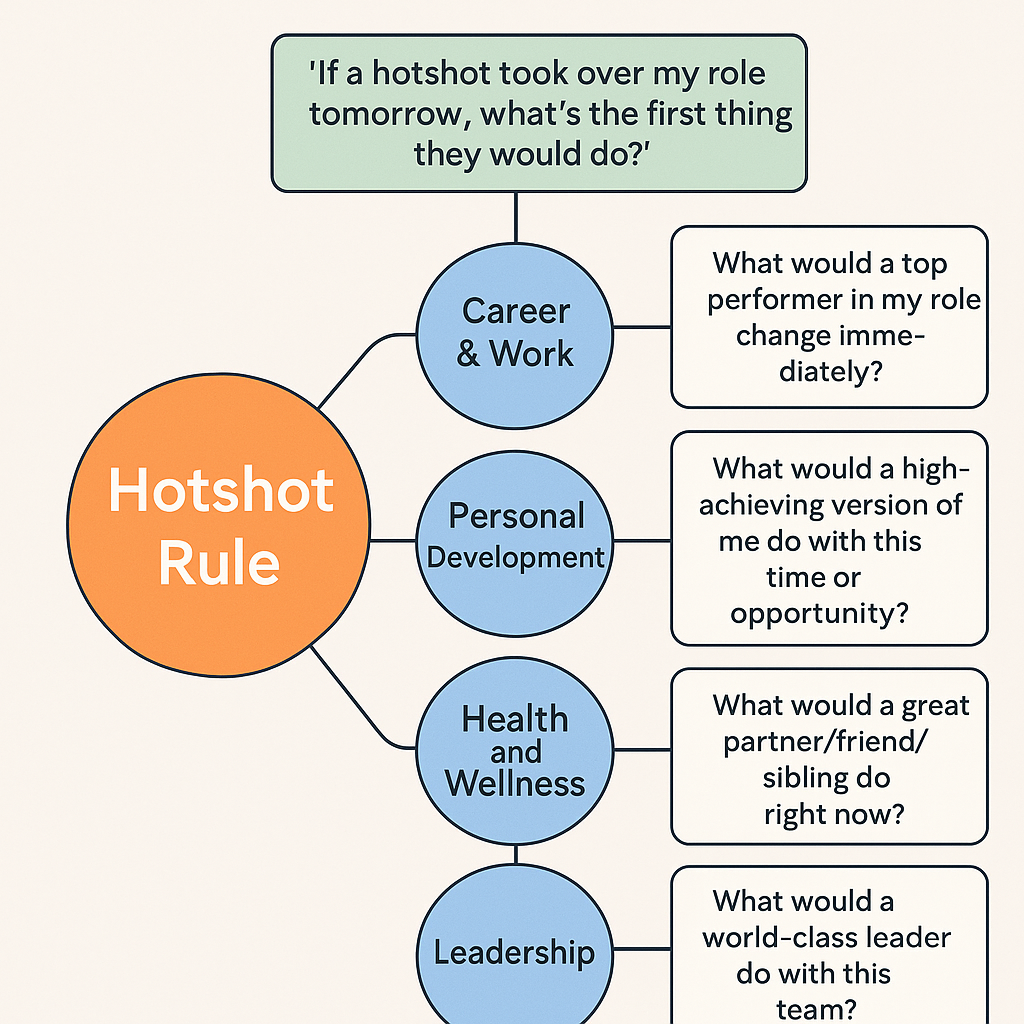
Recently, I came across a TED Talk by a CEO named Kat Cole. She shared a powerful method that helped her think differently and move forward in her professional journey. The tool she mentioned is called the “Hotshot Rule.” It became a game-changer for her career—and it can be applied by anyone: a developer, a CEO, a teacher, a father, or a mother.
The idea is simple: Ask yourself—if someone smarter than you were to replace you tomorrow, what’s the first thing they would do? Then—go and do that thing immediately.
When we take on a new role, we often see things with fresh eyes and act decisively. But over time—3 years, 3 months, 4 weeks later—we may lose that clarity. This method helps us regain that fresh perspective.
Also, remember: there’s always someone smarter than you. But instead of waiting for them to replace you—why not replace your old self with a better version of you?
This approach allows us to see through someone else’s eyes—to understand the situation clearly and take meaningful action. And action creates impact.
So how can we apply this in our lives?
First, take full responsibility for all areas of your life.
Then, choose one area—whether personal or professional.
Think of the smartest person you admire as your mentor.
Review that area through their mindset.
Then, take the necessary actions—decisively and without delay.
While reading about self-love, an old memory resurfaced. Someone once tried to remind me of my “Aukaat”—a word that signifies one’s status or worth in life. He told me I did not deserve the best, while he did. “Toh apni Aukaat bhool gaya hai?” he said.
Sometimes, I revisit those words. Why should I not deserve better while others can?
At times, I wonder if “Aukaat” simply means one’s reality, one’s limit. As Chattan Bhagat once pointed out, there is no equivalent word for “Aukaat” in some other languages.
When people remind you of your Aukaat, they are not offering wisdom—they are trying to suppress you, to keep you beneath them. “Teri itni hi Aukaat hai, jo hamara muqabla kar raha hai?” they say, as if worth is something dictated by others.
But with time, I realized a deeper truth: people control others by controlling their thoughts—by suppressing their beliefs about what is possible.
That day, I made a decision. You defined my Aukaat for me once, but one day, I would define it for myself.
And today, when I look at my achievements and compare them to their lives, I see the truth—they were wrong. They were liars. I have accomplished much.
So, remember: when someone tries to tell you your Aukaat, they are not revealing your limits. They are exposing their own. How to change your Aukaat is to take responsibility of your life. Goals and effort to change effort. it take time.
I recently came across this quote, and it caught my attention:
“An expert is a person who has made all the mistakes that can be made in a very narrow field.” — Niels Bohr.
This quote is fascinating because it highlights how someone becomes an expert. Expertise isn’t achieved overnight—it comes through trial and error. A person starts working toward a goal, makes mistakes, learns from them, and gradually improves.
What’s even more interesting is that if a person doesn’t learn from their mistakes, they remain at the same level. Facing failure is tough, especially when you find yourself making the same mistakes repeatedly. But those who embrace their mistakes, analyze them, and adapt are the ones who grow.
This quote resonates deeply with my own life experiences. It reminds me that expertise is built on persistence and resilience.
So, when someone asks, “How do I become an expert in any field?” The answer is simple: Have the will to start, make mistakes, correct them, learn from them, and repeat the process.
I was wondering if it is true that the most successful person in any field is the most talented one. Later, I realized that this is not the case. Most people who are successful in a specific field or career are not necessarily the most talented. Talent matters, but work ethic, effort, and dedication matter even more.
I was reading Angela Duckworth’s book Grit: The Power of Passion and Perseverance. In it, she mentioned that talent multiplied by effort equals skill, and skill multiplied by effort equals achievement.
All successful people have achieved great things in life. A less talented person who puts in effort can become successful, while a talented person who does not put in effort may not achieve the same level of success. Talent is important, but effort has a greater impact.
While driving to the office on a long bike ride, my mind continuously wandered to the past. I kept thinking, What happened to me? Why did that happen to me? By the time I reached the office, my mood had turned sour.
During the ride back home, while driving my bike, my mind shifted to the future. As a result, I felt stressed.
When I sat in silence, I began reflecting on what had happened to me. Why was I so sad? Why was I so stressed? Then, I realized that the only cure for both was to live in the present moment. The present moment is the only truth.
While working in the office, when things weren’t going as planned, I felt stuck. My past failures held me back, and they started to dominate my thoughts, chaining me down.
I decided to focus on two things:
Don’t resist these thoughts.
Don’t feed these thoughts.
Instead, I let them come and go. I focused on the present moment and allowed the thoughts to pass without holding onto them.
Remember, don’t resist them or feed them; otherwise, they will chain you down.
neca, and Epictetus can help us tackle life’s daily challenges. Their timeless insights come from lives spent reflecting on struggles, journaling their experiences, and learning from them.
I’ll also share my personal journey and how journaling has been a powerful tool for self-improvement. Like everyone, I’ve faced fears of job insecurity, family and workplace politics, and betrayal. While we often turn to others to share our challenges, sometimes they don’t understand or may even seem indifferent. But I discovered that journaling—a practice used by many wise figures through history—can be a valuable tool for processing our struggles.
Journaling allows us to reflect, grow, and cultivate inner peace. Today, I’ll discuss why it’s essential and how it can benefit you.
1. Goal Setting and Reminders
One of the most immediate benefits of journaling is setting and realigning with your goals. Writing them down gives direction to our lives and helps us stay true to our purpose.
Marcus Aurelius once said:
“At dawn, when you have trouble getting out of bed, tell yourself: I have to go to work—as a human being. What do I have to complain of, if I’m going to do what I was born for—the things I was brought into the world to do?”
Journaling about our goals reinforces them and gives us the motivation to keep moving forward.
2. Overcoming Fear
Fear can often be exaggerated in our minds, and many of our worries never come to pass. Journaling allows us to confront and analyze these fears, making them feel more manageable.
Seneca put it well:
“We suffer more often in imagination than in reality.”
Writing down our fears helps us understand where they stem from and whether they’re real or imaginary. Through reflection, we can address these fears constructively.
3. Growth Through Self-Knowledge
Epictetus encouraged examining ourselves closely:
“Examine yourself… Make it a habit to scrutinize your thoughts, actions, and attitudes, even the small ones.”
Journaling allows us to track our daily actions and thoughts, examining why we do what we do. By asking questions like, “Why did I think this?” or “What led me to act this way?” we gain a clearer understanding of ourselves, fostering personal growth.
4. Reflecting to Improve Daily
Daily reflection helps us evaluate our actions and work towards becoming better each day. This process lets us identify our strengths and weaknesses, helping us grow over time.
Marcus Aurelius reminds us:
“Look within. Within is the fountain of good, and it will ever bubble up, if thou wilt ever dig.”
Similarly, Seneca advised:
“Every night before going to sleep, we must ask ourselves: What weakness did I overcome today? What virtue did I acquire?”
Journaling brings discipline and clarity to our lives. It keeps us aligned with our values and helps us stay grounded in what matters most.
In Stoic philosophy, journaling and reflection are daily practices that keep us mindful, reminding us of our values and allowing us to handle life’s challenges with greater peace and purpose.
If you found this video helpful, please like, subscribe, and join us for more on self-improvement and Stoic wisdom.
When we try our best to achieve our dreams, the fear of failure starts to appear in our minds. Will I succeed? Am I on the right path? Are my dreams worth my time and energy? Similar questions began to cross my mind, causing my confidence to waver, which in turn dampened my efforts. Many times, we decide to switch jobs. When are we going to apply online? Job portal. Many similar questions start to appear in our minds. Will they check my CV? There are other applicants. What will happen if they do not reply? What if they reply and I fail the interview? Will it be worth it to apply for a job? Many times in life, I became aggressive and angry when I faced rejection.
The solution to all these challenges is a stoic mindset.
In this video, here are four things you need to master to build a stoic mindset.
Let’s discuss these four points, as well as how my journey as a stoic began.
I started reading the famous book Meditation by Marcus Aurelius. His notes to himself. His journal. In his journal, he reflects on his days, events, and happenings. [[Marcus Aurelius]] was reputedly a powerful man. He dedicated his entire reign to interacting with the populace. Dealing with adversity. He saw wars. He witnessed the [[Pandemic]] of Diseases . The Pandemic and war both claimed the lives of his many loved ones and relatives. He deals with all those challenges and leaves behind his notes, where he records the moral and psychological advice he gave himself at this time. This journal, which he never intended to publish, serves as the foundation for the entire Stoic philosophy. After that, I started studying more and developed a stoic [[mindset]].
Building a stoic mindset will not happen in a day; it will require consistent effort. A strategic shift will change your prospects in life.
Dealing with [[Adversity]]
If you face adversity, remember what Marcus Aurelius said. “The impediment to action advances action. What stands in the way becomes the way.” _
It refers to the adversity you are currently facing in your life; understand this and base your goals accordingly. Work on it until you find a way. Your weakness becomes your strength.
However, if you have a stoic mindset, you should consider the adversity you are experiencing as a worthwhile endeavor. You must focus your [[efforts]] and [[hard work]] in the right direction. Many times you feel adversity, you just need to let it go.
The second important point of having a Stoic mindset is to accept fate but take action as duty. “The Amor Fati.”. For example, I was thinking about applying for a job on a job portal. Numerous [[negative thoughts]] crossed my mind, including the possibility that they wouldn’t consider me. What would happen if I received a call for an interview and faced [[rejection]] ?
To have a stoic mindset, you have to accept fate as it is. But act like it is your duty. We simply need to concentrate on the tasks at hand. Update your CV and apply. Review the job description. Study it, adjust your CV accordingly, and then apply. Some ancient Indian texts talk about considering it your duty to do what is necessary and to detach from the future. Accept the result without thinking about it. Don’t be discouraged; move on.
Control is the third-most important thing in the Stoic mindset. As [[Epictetus]] “It is not events that disturb people; it is their judgments concerning them.” In between actual events and our emotions, there is one thing, and that is our judgment. Our judgment is based on the lens we have in our eyes, through which we see the whole world. I am referring to our beliefs, our thoughts, and our perspective on the world. Being stoic requires us to change our thoughts; we must change the lens through which we see the world. As Epictetus said “Some things are up to us, and some are not. Up to us are opinion, intention, desire, aversion, and, in a word, whatever is our own doing; not up to us are body, property, reputation, office, and, in a word, whatever is not our own doing.”
To build a stoic mindset, we need to just focus on what we can control. And that control changes our judgment. It’s ok, what happened? I got rejected. Ok, fine. What I need to do now is move away and give it another try. We should concentrate on improving the situation. Instead of concentrating on the situation at hand, we tend to focus on the opinions of others. Our thinking and our judgment create an embarrassing situation. Here, we are focusing on things that are beyond our control. What people think about us. That is beyond our control. As a result, we experienced feelings and emotions. Because we have a stoic mindset, we have to think of solutions.
I hope you like this video. On closing notes, building a stoic mindset is not difficult; we need to constantly remind ourselves of a few principles and adjust our thinking. We have to accept fate, as it either moves on or tries again. While processing dreams and chasing goals, we did not think about the outcome; we just put in our efforts to perform our next step. When faced with adversity, if it is worth it, transform it into a goal. Take actions to the point where obsessiveness becomes the norm. Always focus on things that we can control. What we can control is our attitude toward life. Be positive and stay humble.
Our mind produces more than 60000 thoughts per day. Most of them are negative. Some estimate that more than 45,000 thoughts are negative. Let’s say those are right. Most of the time, we were anxious about what people would think. Perhaps they simply take pleasure in the events that unfold in our lives. If we focus on what others think or say about us, we end up becoming their version of ourselves.
We cannot control our thoughts. One of the Buddhist ways to control thoughts is to intentionally think about something else. Most of the saints chant. They mentally focus on the meaning of the chanting words. Some engage in breath meditation. They begin by focusing on the inhalation and exhalation of their breath. This allows them to control their thoughts.
To control thoughts, you must stop resisting them. Let them come and go. Accept them as they are. Don’t give them any power. It’s in our hands, which we thought we gave them. Acceptance has power. Remember: whatever you resist, persist.
But remember what Marcus Aurelius said. “The happiness of your life depends upon the quality of your thoughts. “ This forces us to think in opposition to our initial thoughts. We choose our thoughts. Hope you like this post.
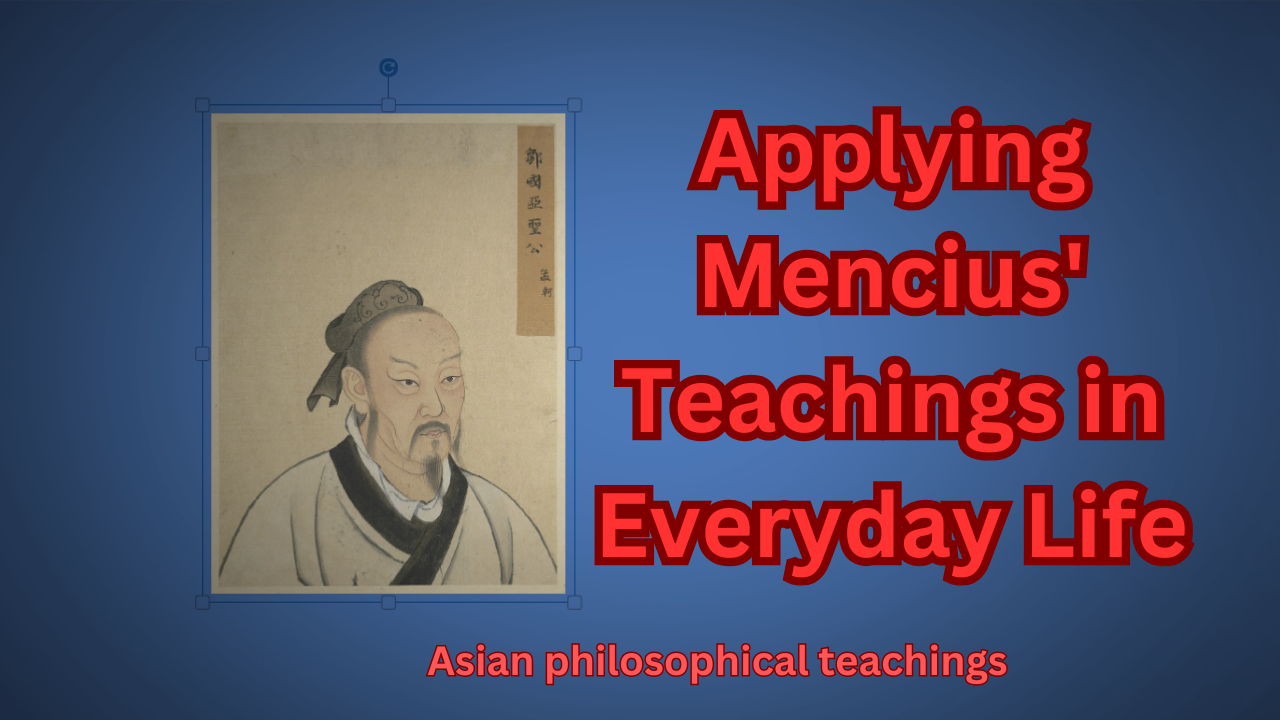
Hello and welcome to this video. In this video, we explore the teachings of the ancient Chinese philosopher, Mencius. It’s commonly believed that Mencius lived during the emergence of city states. Most of his teachings focused on enhancing state-related affairs, but in this video, we explore how we can apply his teachings in our personal lives.
So the question is: who is Mencius? Even before choosing this topic, I did not know him. Mencius is considered to be the second saga of Confucianism. He lived in 289 BC. He lived during the Chinese Warring States period approximately 2,300 years ago. He expanded and finalized Confucius’ teachings.
According to Mencius, every human is born with a righteous or upright nature. Later in life, they may lose their way. Their circumstances or environment shaped them, and they lost the right path. According to him, with proper nourishment and care, everything grows, and without the proper nourishment and care, everything degenerates or decays.
Now we discuss four innate virtues in humans. Often referred to as the four beginnings or the four seeds of goodness, I have mentioned them and provided a brief explanation to help us apply them to our personal lives.
Sense of Compassion (仁, Ren): On a personal level, we need to practice empathy in our interactions with others. Always consider their feelings and strive to comprehend their perspective by putting ourselves in their shoes. Help and support them in their day-to-day tasks. Seek opportunities to assist them with their daily tasks and issues. implement a sense of compassion.
Sense of Shame and Disdain (義, Yi): Understand and always act on those things that are morally right. Try to avoid acts that are morally wrong. Make choices and decisions based on a moral compass.
Sense of Respect and Reverence (禮, Li): Many times we think of breaking social norms and traditions. But that is not the right virtue. Always respect social norms and traditions.
Sense of Wisdom (right and wrong) (智, Zhi)**: Seek knowledge and understanding in every situation. Reflect on your experiences and learn from them. Use your life wisdom to make good decisions.
We can apply Menicus teaching by reflecting on our lives. Regularly reflect on your actions and interactions. Evaluate your actions with respect to your values. If this isn’t the case, it’s important to make changes in your life. Always maintain the belief that every individual possesses a good nature from birth. If a person exhibits negativity, it’s likely due to external circumstances. Always focus on helping and your fellow beings. Always seek balance in life.
I hope friends like this video. Mencius focuses on moral virtues. We can improve our lives by adhering to these rules.